
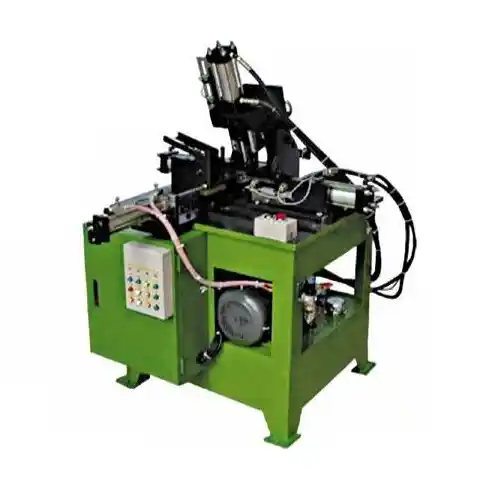
HANDLEBAR STEM DOUBLE ENDS NOTCHING
Model:JD-31
Add to inquiry
Product Specifications
|
Detail
The JD-31 is a seat tube double-end automatic arc punching machine designed for bicycle frame production. It forms matching arcs on both ends of the seat tube in a single cycle, helping frame factories keep tube geometry consistent before welding to the bottom bracket or other frame parts.
This machine is powered by a hydraulic system that maintains stable forming force for each stroke. Combined with a compact footprint of 170 x 105 x 146 cm and a weight of about 500 kg, the JD-31 fits well into existing bicycle frame production lines and can be integrated near cutting, mitering, and welding stations.
As a notching machine manufacturer focused on bicycle applications, the design of the JD-31 reflects the needs of frame builders who work with different tube sizes, materials, and yearly production volumes.
Applications and Compatible Tube Types
The JD-31 is built for bicycle seat tube and related round tube applications where both ends require arc forming or notching.
1. Typical Bicycle and Tube Applications
The machine is suitable for:
- City bike and trekking bike seat tubes
- MTB and BMX frame seat tubes
- Tubes that must fit precisely to bottom brackets, top tubes, or gussets
Typical tube types include:
- Carbon steel bicycle tubes
- Alloy steel tubes
- Stainless steel tubes
- Aluminum tubes (depending on wall thickness and forming design)
Actual forming range, tube outer diameter, and tube length can be discussed based on customer drawings and tube material.
Key Features for Production and Process Engineers
1. Double-End Forming in One Cycle
The JD-31 clamps the tube, then forms arcs on both ends during one machine cycle. This reduces handling time and minimizes alignment errors that often occur when each end is processed separately. For factories running large batches of similar frame sizes, this design can simplify fixture setups and shorten overall cycle time.
2. Hydraulic Drive for Stable Forming
The hydraulic drive system provides repeatable force for every stroke. This helps keep the arc depth and contact surface consistent from part to part, which is important for welding and later frame alignment.
Process engineers can tune pressure and forming parameters within the designed range to match different tube materials and thicknesses. This flexibility supports frame lines that handle multiple bicycle models.
3. Operator-Friendly Layout and Safety
The JD-31 layout supports straightforward loading and unloading of tubes. Controls are grouped within easy reach so operators can monitor the forming process, start and stop cycles, and respond quickly if anything unusual happens.
Safety measures may include:
- Two-hand control or similar safeguards for cycle start
- Mechanical guards and covers around the forming area
- Clear access for inspection and maintenance
These measures aim to reduce risk for operators during daily use.
Integration into Bicycle Frame Production Lines
1. Upstream and Downstream Compatibility
The JD-31 can be positioned after tube cutting and before welding stations in a bicycle frame production line. With proper layout planning, it can work together with:
- Tube cutting or sawing machines
- Tube end preparation or notching equipment
- Frame welding fixtures and stations
FAQ
1. How many operators are needed to run the JD-31?
In most setups, one operator can load and unload tubes, manage the control panel, and monitor the process. For highly automated lines with upstream and downstream equipment, the JD-31 can be placed within a cell where one operator oversees several machines, depending on plant layout and safety rules.